

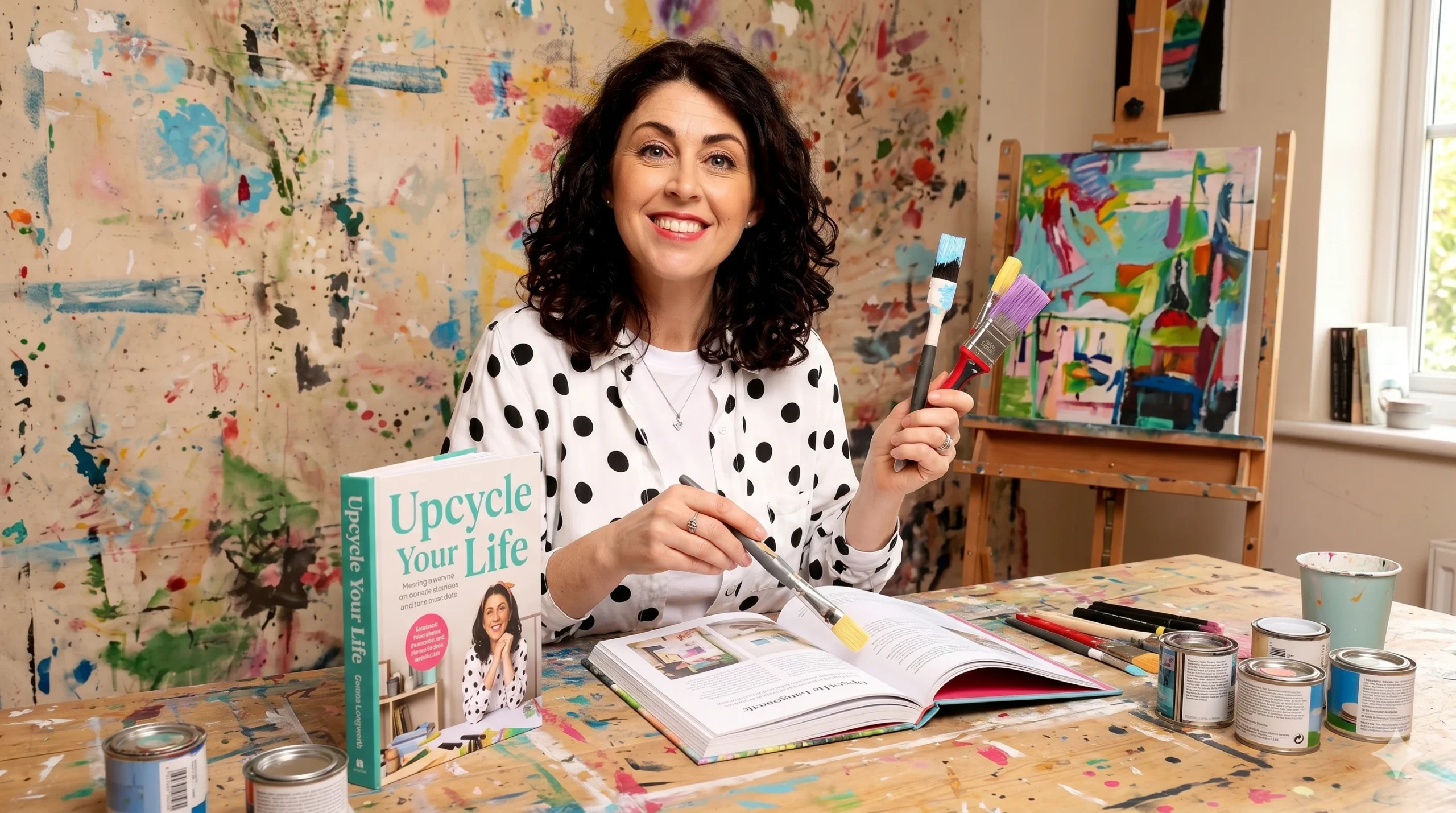
Gemma Longworth became familiar to many viewers through the satisfying rhythm of restoration television: an unwanted piece is found, fixed, reimagined, and sent back into the world with a new value. But her story is larger than the before-and-after reveal. Longworth is a Liverpool-based artist, furniture upcycler, television presenter, author, workshop leader, and founder of a creative support project that connects making with memory, grief, confidence, and care. Her public life sits at a rare crossing point: practical craft, television appeal, sustainability, and the quiet emotional work of helping people make something when words are hard to find.
Best known for her work on Channel 4’s Find It, Fix It, Flog It, Longworth has built a career on seeing possibility in things other people might overlook. A tired cabinet, a box of buttons, a damaged chair, or a blank workshop table becomes a chance to repair, reuse, and reconnect. That is the thread running through her television work, her early craft business The Button Boutique, her book Craft Your Cure, and her community project Hidden Gems. She has never been a celebrity in the flashy sense, and that may be part of her appeal: her work feels close to home, rooted in hands-on skill, and shaped by the belief that creativity can help people through difficult times.
Early Life and Liverpool Roots
Gemma Longworth is strongly associated with Liverpool, the city that shaped much of her training, early business life, and community work. Public biographical material places her education and career development in the Merseyside creative world, where art, textiles, teaching, and community projects often overlap. Unlike many television personalities whose profiles are dominated by red-carpet events or personal publicity, Longworth’s public record is built more quietly through workshops, local enterprise, hospital-linked support, and practical creative work. That makes her biography less about sudden fame and more about a long, steady relationship with making.
Publicly available information about her childhood and immediate family is limited, and that boundary should be respected. Some online biography pages repeat claims about her birthday, family life, and private relationships, but many do so without strong sourcing or direct confirmation. What can be said with confidence is that Longworth’s professional identity grew from art and design rather than from entertainment media. Her route into public view came through skill, not celebrity branding.
Liverpool matters in this story because it is not just a location on a biography page. Longworth’s work with Alder Hey Children’s Hospital and The Alder Centre connects her creative practice to one of the city’s most significant institutions. Her early business activity also reflects a local maker culture built around workshops, independent craft, fairs, teaching, and community events. That background helps explain why her later television presence feels grounded rather than manufactured.
Education and Early Creative Training
Longworth trained in art and textiles before she became known on television. Public profiles have described her as having studied art and design at the City of Liverpool College, followed by further higher education in applied arts and textiles. Publisher material for her later book also describes her as having a degree in applied arts, a Master’s in textiles, and postgraduate study in therapeutic arts. That combination is important because it places her work at the meeting point of material skill and emotional support.
Textiles are not just a decorative interest in Longworth’s career. They require patience, a feel for surface and structure, and an understanding of how small details can change the character of an object. Those qualities carry into her furniture upcycling, where paint, fabric, pattern, and finish can transform the mood of a piece without erasing its past. Her training also helps separate her from the casual “craft influencer” category: she brings formal study as well as instinct to the work.
Her postgraduate connection to therapeutic arts helps explain the direction her career later took. Longworth’s public projects do not treat creativity as a simple hobby or a cheerful distraction. They present making as a way to focus attention, process feeling, build confidence, and create something tangible during difficult periods. That approach has become central to how she is understood by readers, viewers, and families who encounter her work outside television.
The Button Boutique and the Start of a Public Craft Career
Before television brought her to a wider audience, Longworth built a name through The Button Boutique. The business grew from her love of vintage materials, handmade objects, and creative workshops. Early descriptions of the project connected it to buttons, fabrics, beads, accessories, textile art, craft parties, and bespoke handmade pieces. It was the kind of enterprise that often begins small but teaches the full discipline of creative work: designing, sourcing, making, teaching, promoting, and adapting to what people actually want.
The Button Boutique also revealed Longworth’s interest in reuse long before upcycling became a mainstream television category. Collecting old materials asks for a particular kind of attention. A button is not just a fastening; it can carry colour, age, texture, memory, and charm. A scrap of fabric can become part of a new object if the maker has enough imagination and skill to see its next life.
This early period appears to have been driven by self-made opportunity. Rather than waiting for a perfect creative job, Longworth created work through workshops and handmade products. That entrepreneurial start matters because it foreshadows the rest of her career. Whether on screen, in a hospital-linked setting, or through a published book, she has continued to build practical spaces where creativity is not remote or elite but something people can try with their own hands.
Television Breakthrough on Find It, Fix It, Flog It
Longworth became best known to the wider public through Find It, Fix It, Flog It, the restoration programme associated with Channel 4 and later wider repeat and digital viewing. The format is simple but effective: neglected objects are found, repaired, redesigned, and sold. Its pleasure lies in transformation, but also in the small education that happens along the way. Viewers learn to look again at objects that might otherwise be dismissed as old, damaged, or unfashionable.
As a presenter and furniture upcycler on the programme, Longworth brought warmth, colour, and practical confidence. She was not there simply to describe what was happening; she was part of the making process. Her screen work drew on the same qualities that shaped her earlier workshops: an eye for potential, comfort with materials, and the ability to make a project feel possible rather than intimidating. For many viewers, she helped turn restoration from a specialist activity into something approachable.
The success of this kind of television depends on trust. Audiences want the reveal, but they also want to believe the person doing the work understands the object. Longworth’s background in applied arts and textiles gave her credibility in that role. She could talk about colour, surface, reuse, and repair from experience, and that made her presence feel more like a working maker sharing a process than a presenter performing enthusiasm.
Why Her Upcycling Work Resonates
Longworth’s upcycling connects with viewers because it sits between thrift, design, and emotion. People often keep furniture for reasons that are not purely practical. A chair may come from a relative, a table may have followed a family through several homes, or an old cabinet may simply feel too solid to throw away. Upcycling offers a way to keep the object without keeping it frozen in the past.
There is also a clear environmental appeal. Reusing furniture can reduce waste, slow down unnecessary buying, and remind people that old materials often have more life left in them than modern shopping habits suggest. Longworth’s work does not need to make grand claims to matter. Each project says something modest but useful: before you replace something, look at whether it can be repaired, adapted, or made beautiful again.
Her style also suits viewers who feel nervous about craft. She does not present making as a perfection contest. The appeal is in trying, learning, and seeing change happen through small decisions. That is why her television work and her later wellbeing-focused projects fit together: both are about giving people permission to begin, even when the starting point looks damaged or uncertain.
Hidden Gems and Creative Support
Hidden Gems is one of the most meaningful parts of Longworth’s public work. The project presents art and craft workshops as a form of creative support for people of different ages and circumstances. It is not only about making attractive things; it is about using the act of making to create a positive, safe, and hopeful environment. That mission reflects the same belief that runs through Longworth’s book and hospital-linked work: creativity can help people hold difficult experiences in a gentler way.
Gemma’s Hidden Gems CIC was incorporated as a Community Interest Company in October 2024, giving formal shape to work that Longworth had already been known for in practice. A CIC structure matters because it indicates a community benefit purpose rather than a purely private commercial venture. For Longworth, that formal step placed her creative support work on a clearer public footing. It also suggested a desire to build something lasting beyond one-off workshops or television appearances.
The project’s name carries a double meaning. It echoes Longworth’s own first name, but it also points to the idea that hidden value can be found in people and objects alike. That idea could easily sound sentimental, yet her work gives it practical form. A workshop table, a set of materials, and a clear invitation to make something can create space for people who may not know where else to put their feelings.
Alder Hey, Bereavement, and Work With Young People
Longworth’s connection with Alder Hey and The Alder Centre gives her public biography unusual depth. The Alder Centre is known for support around child bereavement, and listings for Alder’s Hidden Gems describe a creative bereavement support group for children and young people affected by the death of a child. The group has been described as a collaboration between wellness artist Gemma Longworth and The Alder Centre. This is serious work, and it should be understood with care.
Creative bereavement support is not about asking children to produce polished art. It gives them a structured activity at a time when direct conversation may feel too difficult. Making can allow grief to sit beside colour, texture, memory, and choice. For young people facing loss, that kind of setting can offer both expression and containment.
Longworth’s role in this area also helps explain why her public image feels different from that of a standard TV craft presenter. Her career is not only about showing viewers what paint can do to a chest of drawers. It is also about what making can do for a person trying to live with pain, change, or memory. That does not make craft a cure for grief, but it does make it a meaningful tool when used with care and the right support around it.
Craft Your Cure and the Personal Turn
Longworth’s book, Craft Your Cure: 25 craft and upcycling projects to heal and bring joy, brought her central ideas into print. Published by Watkins, the book presents a collection of projects connected to craft, upcycling, memory, and emotional repair. Its title is direct, but the spirit of the book is practical rather than clinical. It speaks to readers who want a project they can hold, complete, and perhaps connect to something personal.
The book’s subject matter reflects Longworth’s unusual position between craft instruction and emotional wellbeing. It is not simply a manual for painting furniture, and it is not a self-help book detached from physical making. It asks readers to see creativity as an active process, something that happens through hands, time, choice, and attention. That makes it consistent with the rest of her career rather than a sudden brand extension.
A book also changes the scale of a maker’s work. Workshops are intimate, and television is visual and edited, but a book allows readers to move at their own pace. Someone can return to a project weeks or months later, adapt it with their own materials, or use it privately during a difficult time. For Longworth, Craft Your Cure appears to extend the workshop table into the reader’s home.
Public Image and Media Presence
Longworth’s public image is built around warmth, practicality, and emotional openness. She is not framed primarily as a high-end designer or a glossy lifestyle personality. Instead, she comes across as a working creative who can teach, repair, present, and support. That combination has helped her appeal to viewers who want skill without snobbery.
There is also a strong sense of accessibility in how she is presented across her public work. Her workshops are described as suitable for different ages and group sizes, and her television projects show everyday objects being given another chance. The message is clear: creativity is not reserved for people with perfect studios or expensive materials. It can start with an old frame, a worn chair, a piece of fabric, or a memory that needs somewhere to go.
This accessible image is also why readers search for personal details about her. They feel they know her from screen work and want to understand the person behind it. But here’s the thing: the most trustworthy picture of Longworth comes from her work rather than from loosely sourced claims about private life. The public record is strongest where it documents her training, projects, television role, book, and community activity.
Family, Marriage, and Private Life
Longworth appears to keep much of her private life out of the public record. Some websites publish claims about her husband, children, or family background, but these details are not consistently supported by reliable primary sources. For that reason, a careful biography should not present them as confirmed fact. Respecting that boundary is part of responsible profile writing, especially for a public figure whose work is known but whose personal life is not heavily publicized.
What is clear is that family, memory, and care are themes in her public projects. Her work with bereavement support and her book’s focus on healing suggest a deep interest in how people carry personal experience through objects and making. That does not give outsiders permission to fill in private gaps with guesses. It simply shows that her professional work is emotionally aware and shaped by human experience.
Readers often ask about marriage and children because search culture encourages quick personal answers. In Longworth’s case, the honest answer is that those details are not as well established in reliable public material as her career is. That may disappoint readers looking for a complete private biography, but it is the more accurate and respectful position. The absence of confirmed information should not be treated as an invitation to invent.
Income Sources and Net Worth
Gemma Longworth’s likely income sources include television work, creative workshops, public events, book royalties, and project-based arts activity. She has also built value through her professional profile as a maker, presenter, author, and founder of a CIC. Those are credible areas of income for someone in her position. What is not credible is pretending to know her exact personal wealth without documents that prove it.
Online net worth estimates for Longworth should be treated with caution. Many celebrity biography sites generate figures without showing contracts, accounts, royalty statements, property records, or other meaningful evidence. These estimates can be repeated across the web until they look established, but repetition does not make them reliable. A serious biography should label such figures as estimates at best and avoid using them as fact.
The more useful financial picture is that Longworth has built a diversified creative career. Television can raise visibility, workshops can create direct community and commercial work, books can extend a brand and message, and a CIC can support mission-led projects. That is a strong professional model, even without a confirmed wealth figure. It shows a career built across several related channels rather than dependent on one screen role.
Setbacks, Grief, and Turning Points
Longworth’s work around healing suggests that difficult experience has shaped her public mission, though private details should be handled carefully. Publisher descriptions of Craft Your Cure refer to her personal story being woven through the book, and her work with bereavement support makes clear that loss is not a distant subject in her creative world. She has built a public practice around the idea that making can help people move through pain, rather than pretend pain is not there. That gives her work emotional weight.
The turning point in her career may not be a single TV booking or book deal. It may be the gradual recognition that craft, for her, could be both livelihood and care work. The Button Boutique showed her ability to make and teach; Find It, Fix It, Flog It gave her a wider audience; Hidden Gems and Craft Your Cure gave her message a sharper emotional purpose. Taken together, these stages show a career that has become more personal over time.
That evolution is what separates Longworth from many television makers. She did not simply remain in the lane of upcycled furniture and cheerful reveals. She moved toward harder territory: grief, memory, wellbeing, and the support of young people. That choice suggests a public identity built not only on talent, but on conviction.
What Gemma Longworth Is Doing Now
Longworth’s current public work appears to centre on Hidden Gems, creative workshops, her book, and her continuing identity as an upcycler and presenter. The formal incorporation of Gemma’s Hidden Gems CIC in 2024 suggests a recent effort to develop the community side of her work. Her author profile and book publication also place her in a new phase, one where her ideas can reach readers beyond television and live workshops. That makes this a period of expansion rather than retreat.
Her connection to Find It, Fix It, Flog It remains an important part of how audiences find her. Television has a long afterlife through repeats, streaming, clips, and casual viewing, which means new viewers continue to discover presenters long after episodes first air. Longworth benefits from that because the show’s subject is evergreen. People will always have old furniture, limited budgets, and curiosity about what can be saved.
At the same time, her newer work suggests she is not relying only on screen recognition. Hidden Gems and Craft Your Cure place her in the growing field of creative health, where art, making, and community support are used to help people with emotional, social, and practical needs. For Longworth, that seems less like a trend than a natural home for the skills she has been building all along.
Cultural Influence and Why She Matters
Gemma Longworth matters because she represents a type of public creative figure whose influence is practical rather than loud. She is not changing culture through spectacle. She is changing how some viewers and participants think about discarded objects, handmade work, and the emotional value of making. That kind of influence can be easy to underestimate because it happens in homes, workshops, and support groups rather than on major award stages.
Her work also reflects a broader shift in how people talk about craft. For years, craft was often treated as either a hobby, a cottage industry, or a decorative extra. Longworth’s career places it closer to wellbeing, sustainability, memory, and community care. That does not mean every project carries deep meaning, but it does mean the act of making deserves more respect than it is often given.
There is also a democratic quality to her message. Not everyone can commission a designer, renovate a home, or buy new furniture whenever taste changes. But many people can sand, paint, stitch, glue, repair, decorate, or begin with a small object that matters to them. Longworth’s career reminds readers that creativity is often most powerful when it is ordinary enough to be used.
Frequently Asked Questions
Who is Gemma Longworth?
Gemma Longworth is a British artist, furniture upcycler, television presenter, author, and creative workshop leader. She is best known for appearing on Find It, Fix It, Flog It, where she works with unwanted or overlooked items and helps give them a new life. Her wider career includes The Button Boutique, Hidden Gems, craft workshops, and the book Craft Your Cure.
She is closely associated with Liverpool and with creative work that blends art, reuse, and emotional support. Her public identity is rooted in practical making rather than celebrity culture. That is why she appeals to viewers who care about homes, sustainability, craft, and wellbeing.
What is Gemma Longworth famous for?
Longworth is famous for upcycling furniture and presenting on Find It, Fix It, Flog It. The show introduced her to a broad audience and showed her ability to turn neglected objects into useful and attractive pieces. Her work on screen fits naturally with her background in applied arts, textiles, and hands-on teaching.
She is also known for her creative support work through Hidden Gems. That side of her career focuses on art and craft workshops that can help people express themselves, build confidence, and process difficult experiences. Her book Craft Your Cure brought those ideas into a published format.
Is Gemma Longworth married?
Reliable public information about Gemma Longworth’s marriage or family life is limited. Some websites make claims about her relationship status, but many do not provide strong sourcing or direct confirmation. For that reason, those details should be treated carefully rather than repeated as fact.
Longworth’s public profile is much clearer on her professional work than on her private life. She appears to have chosen to keep many personal details away from the centre of her public identity. A respectful biography should follow the evidence rather than fill the gaps with speculation.
Does Gemma Longworth have children?
There is no widely verified public record that should be treated as definitive on whether Gemma Longworth has children. Online claims about private family details are not always supported by reliable sources. Unless Longworth confirms such information directly, it is better not to present it as established fact.
What is publicly clear is her work with children and young people through creative support settings. Her collaboration connected to The Alder Centre has been described as helping children and young people affected by the death of a child. That professional work should not be confused with details about her own family life.
What is Gemma Longworth’s net worth?
Gemma Longworth’s exact net worth is not publicly confirmed. Any figure found online should be treated as an estimate unless it is supported by clear financial records, contracts, accounts, or direct reporting. Many net worth pages use guesswork and repeat each other without showing evidence.
Her likely income sources include television work, workshops, book-related earnings, events, and creative projects. She has built a career across several connected areas, which suggests professional stability and range. Still, a precise personal wealth figure cannot be responsibly stated from the available public record.
What is Craft Your Cure about?
Craft Your Cure is Gemma Longworth’s craft and upcycling book focused on creative projects, healing, memory, and joy. The book includes 25 projects and reflects her belief that making things can help people during difficult periods. It connects her practical skills as an upcycler with her interest in emotional wellbeing.
The book should be understood as a creative guide rather than medical advice. Its value lies in giving readers practical projects that encourage focus, expression, and personal meaning. It extends the spirit of Longworth’s workshops into a format people can use at home.
What is Gemma Longworth doing now?
Gemma Longworth’s current public work appears focused on creative support, upcycling, workshops, and her author profile. Hidden Gems, now formally structured as a CIC, points to her continued investment in community-based creative work. Her television profile also continues to introduce her to viewers through Find It, Fix It, Flog It and related viewing platforms.
She seems to be in a phase where her public identity is broader than television alone. The work now connects repair, memory, grief, confidence, and sustainability. That combination gives her career a clear direction and a strong reason to remain relevant.
Conclusion
Gemma Longworth’s biography is the story of a maker who turned practical craft into a public language. She began with art, textiles, workshops, and handmade objects, then found a wider audience through television upcycling. From there, she moved toward work that treats creativity not only as decoration, but as care.
Her life in the public record is not fully open, and that is part of the truth. Details about her family, marriage, children, and personal finances are not as firmly documented as her professional achievements. Rather than weaken the story, that boundary helps keep the focus where the evidence is strongest: on the work she has chosen to share.
What makes Longworth interesting is not only that she can transform furniture. It is that she has applied the same instinct to people, memory, and difficult experience. She sees value where others may see damage, waste, or silence, and she has built a career around helping others see it too.
For viewers, readers, and workshop participants, that is her lasting appeal. Gemma Longworth offers a practical kind of hope: not the promise that everything broken can be made perfect, but the belief that many things can still be held, repaired, reworked, and loved again.
