

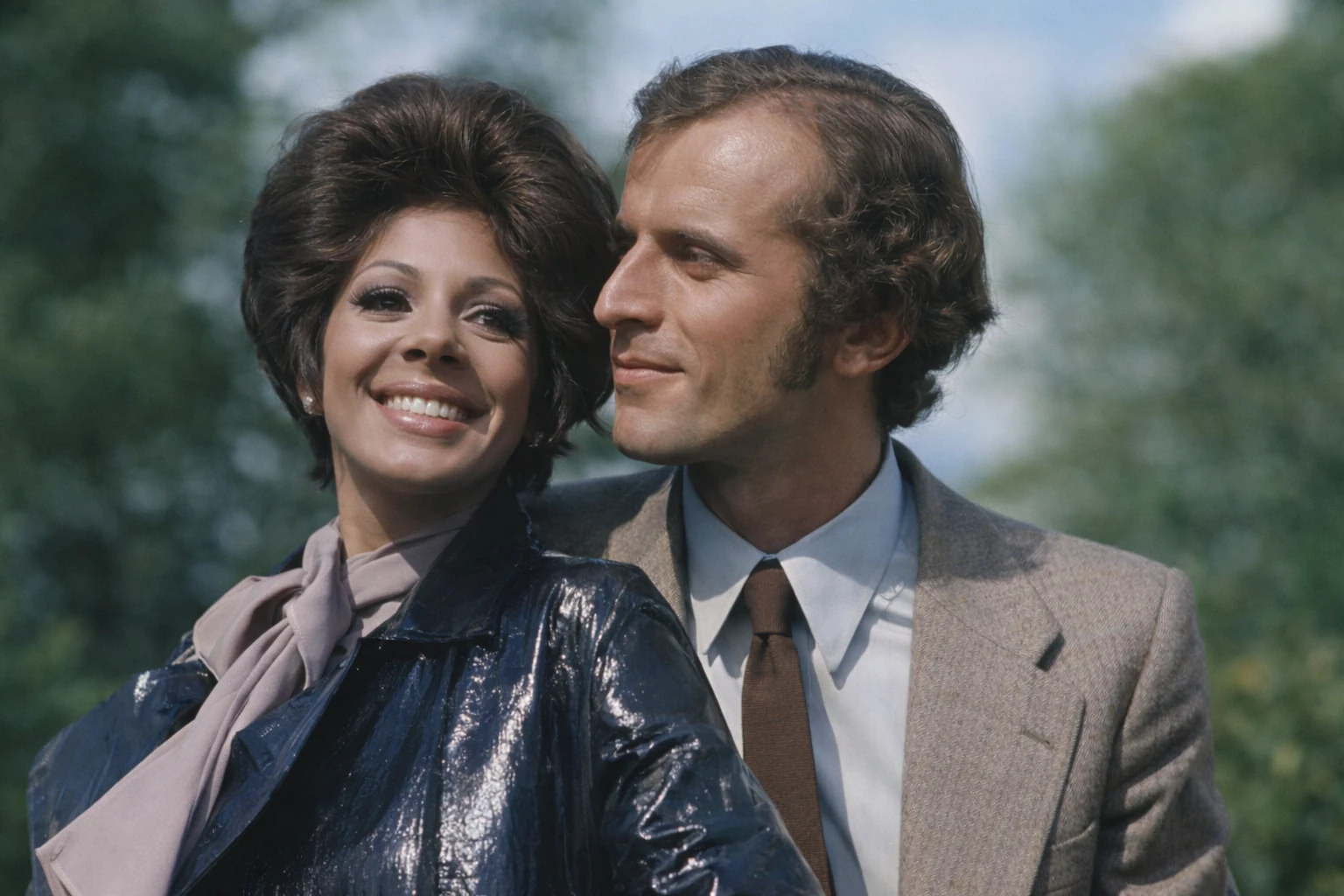
Sergio Novak never set out to become a public figure, yet his name continues to surface decades after his most visible years. That persistence has less to do with a personal legacy built in headlines and more to do with proximity—he stood beside one of the most recognizable voices of the 20th century, Shirley Bassey, during a defining stretch of her life and career. In a culture that often forgets those who work behind the scenes, Novak occupies a curious middle ground: not quite anonymous, not quite famous, but still present in the historical record.
His story is one of partial visibility. There are photographs, scattered press mentions, and references in the biographies of others, but no extensive archive of interviews or self-narration. What remains is a life glimpsed through context—through marriage, family, and a period of professional involvement that coincided with Bassey’s resurgence. To understand Sergio Novak is to understand how certain individuals shape events without ever becoming the center of them.
Early Life and Background
The publicly available record on Sergio Novak’s early life is limited, and that limitation itself is telling. He is widely described as Italian, with strong ties to Venice, where he worked in the hospitality industry. Contemporary photo captions from the late 1960s identify him as a hotel manager connected to the Excelsior Hotel, one of Venice’s most prestigious establishments. Beyond that, details about his childhood, education, and family background remain largely unverified.
Not many people know this, but the absence of detailed records about Novak’s upbringing is not unusual for figures whose careers unfolded outside entertainment or politics. Unlike performers or politicians, hospitality professionals rarely leave behind public biographies unless they later cross into celebrity circles. Novak’s transition into public awareness came not through his own career trajectory but through his relationship with someone already in the spotlight.
Some modern websites attempt to fill in the gaps with specific birthplaces or dates, often citing cities like Trieste or assigning a birth year in the early 1930s. The truth is, these claims are difficult to trace to primary sources and should be treated with caution. What can be said with confidence is that Novak was an established professional in high-end hospitality before his name entered the entertainment pages.
A Career in Hospitality
Before his association with Shirley Bassey, Novak’s professional identity was rooted in the world of luxury hotels. The Excelsior Hotel in Venice, where he reportedly worked as an assistant manager, has long been a magnet for international guests, including film stars, musicians, and business elites. Working in such an environment required not only organizational skill but also discretion, cultural fluency, and the ability to manage demanding personalities.
This background likely shaped Novak’s later role in Bassey’s life. Hospitality at that level is less about routine service and more about orchestration—ensuring that every detail aligns with expectations that are often unspoken but exacting. Staff in such positions are trained to anticipate needs, handle pressure, and maintain privacy, all qualities that translate well into the management of a high-profile performer.
Here’s where it gets interesting. While Novak did not come from the music industry, his experience in handling elite clientele would have prepared him for the logistical and interpersonal demands of managing an international star. In many ways, the transition from hotel management to personal management is not as abrupt as it might seem. Both roles involve coordination, negotiation, and a constant balancing act between public presence and private needs.
Meeting Shirley Bassey
Sergio Novak’s entry into the public record begins with Shirley Bassey, whose career was already well established by the time they met. By the late 1960s, Bassey had built a reputation as one of Britain’s most powerful vocalists, known for her commanding stage presence and a string of successful recordings. Her international profile meant that she spent significant time traveling, often staying in high-end hotels like the Excelsior.
It is widely believed that Novak and Bassey met during one of her stays in Venice, though the exact circumstances have not been fully documented. What is clear is that their relationship developed quickly, leading to their marriage on August 12, 1968, in Las Vegas. At the time, Novak was in his mid-thirties, and Bassey was already a global star.
The marriage drew attention not only because of Bassey’s fame but also because of the contrast between their public profiles. She was a performer whose life unfolded on stage and in the press; he was a professional accustomed to working behind the scenes. That contrast would define much of how Novak was perceived in the years that followed.
Marriage and Professional Partnership
Novak’s role in Bassey’s life extended beyond that of a spouse. By the early 1970s, he was publicly identified as her manager, a position that placed him at the center of her professional operations. This dual role—husband and manager—was not uncommon in the entertainment world at the time, but it carried its own set of challenges.
Managing a performer like Bassey required overseeing touring schedules, coordinating media appearances, and negotiating contracts, all while maintaining a stable personal environment. During this period, Bassey experienced a significant resurgence in her career, marked by successful television appearances, strong record sales, and renewed public interest.
What’s surprising is how little direct commentary exists about Novak’s management style. There are no widely cited interviews or firsthand accounts that describe his approach in detail. Instead, his influence must be inferred from the broader context: he was present during a period of sustained professional activity and was publicly acknowledged as part of the management structure.
That said, it would be misleading to attribute Bassey’s success solely to Novak. She had already established herself as a formidable talent, and her career trajectory was shaped by a range of collaborators, including producers, arrangers, and record executives. Novak’s contribution appears to have been part of that larger ecosystem rather than the defining force behind it.
Family Life and Children
The Novak-Bassey marriage also intersected with Bassey’s family life, which adds another layer to his story. Bassey had two daughters, Sharon and Samantha, from earlier relationships, and later adopted a son named Mark. During her marriage to Novak, he became part of this family structure, helping to raise the children.
Samantha, in particular, is often mentioned in connection with Novak because she used his surname. This detail has contributed to ongoing confusion among readers who encounter the name “Novak” in relation to Bassey’s family. It also reflects the extent to which Novak was integrated into their domestic life, not just their public image.
The family’s story took a tragic turn in 1985 when Samantha was found dead in the River Avon in Bristol. Her death, initially ruled accidental, has been the subject of continued speculation and occasional reinvestigation. While Novak is not central to the circumstances of her death, his name appears in reporting about the family, reinforcing his place in the broader narrative.
Family life for public figures often becomes a matter of public record in ways that can be uncomfortable or incomplete. In Novak’s case, his connection to Bassey’s children ensures that his name remains part of discussions that extend far beyond his own actions.
The End of the Marriage
Sergio Novak and Shirley Bassey’s marriage lasted until 1979, when they divorced after more than a decade together. The reasons for their separation have not been extensively documented, and both parties maintained a level of privacy about the details. This lack of public explanation is consistent with the broader pattern of Novak’s life, which resists easy categorization or dramatic narrative.
Divorce, especially in high-profile relationships, often invites speculation. In this case, however, the record remains relatively restrained. There are no widely reported scandals or public disputes that define the end of their marriage. Instead, it appears to have been a gradual separation that concluded without the kind of media frenzy that might have accompanied similar unions.
The absence of sensational details does not diminish the significance of the relationship. For more than a decade, Novak was both a personal and professional partner to one of the world’s most recognized performers. The end of that partnership marked a transition not only in Bassey’s personal life but also in the structure of her career.
Public Image and Media Presence
Unlike many individuals connected to celebrities, Novak did not cultivate a public persona. He rarely appeared in interviews, and his presence in the media was largely limited to photographs and brief mentions in captions. This low profile has contributed to the air of mystery that surrounds him today.
The truth is, Novak’s public image was defined more by association than by self-presentation. He was seen as “Shirley Bassey’s husband” or “Shirley Bassey’s manager,” labels that captured his role but not his individuality. In an era before social media, it was possible to occupy such a position without leaving behind a detailed personal narrative.
This absence has had a lasting effect. Modern readers encountering Novak’s name often expect a full biography, complete with personal anecdotes and career milestones. Instead, they find fragments—enough to establish his identity but not enough to create a complete portrait. That gap has been filled, in many cases, by speculation and repetition of unverified details.
Financial Standing and Net Worth
There is no reliable public estimate of Sergio Novak’s net worth, and any figures circulating online should be treated as speculative. His income during his years with Bassey would likely have been tied to his role as her manager, as well as any prior earnings from his hospitality career. However, without documented financial disclosures, it is not possible to assign a credible figure.
What can be said is that individuals in similar positions—managing internationally successful performers—often had access to substantial financial resources, whether through salaries, commissions, or shared investments. At the same time, such arrangements varied widely depending on contracts and personal agreements.
It is also worth noting that Novak’s financial standing cannot be separated from his relative privacy. Unlike celebrities who publicly display their wealth, he operated largely out of view, which makes it difficult to assess his financial life with precision. In the absence of verified data, the most responsible approach is to acknowledge the uncertainty rather than fill it with guesses.
Later Years and Current Status
Information about Sergio Novak’s later years is sparse, and his current status is not clearly documented in widely accessible sources. Some online accounts claim that he died in the late 1980s, but these claims are not consistently supported by strong, traceable evidence. As a result, they should be treated as unconfirmed.
What’s striking is how completely Novak seems to have receded from public view after his divorce from Bassey. Unlike some former partners of celebrities who remain in the spotlight through interviews or memoirs, he appears to have returned to a private life. Whether by choice or circumstance, he did not continue to engage with the media in a way that would preserve a detailed public record.
This disappearance adds to the sense of ambiguity that surrounds him. Readers searching for “where is Sergio Novak now” often find themselves at a dead end, confronted with the limits of available information. In a world where so much is documented, that absence can feel unusual, but it is also a reminder that not every life unfolds in public.
Frequently Asked Questions
Who is Sergio Novak?
Sergio Novak is best known as the second husband of singer Shirley Bassey and as her manager during part of their marriage. He was originally a hotel executive in Venice and entered public awareness through his relationship with Bassey in the late 1960s. Beyond that, detailed information about his personal life remains limited.
What did Sergio Novak do for a living?
Before his association with Bassey, Novak worked in the hospitality industry, reportedly as an assistant manager at the Excelsior Hotel in Venice. During his marriage to Bassey, he also took on the role of her manager, overseeing aspects of her professional life.
When did Sergio Novak marry Shirley Bassey?
Sergio Novak married Shirley Bassey on August 12, 1968, in Las Vegas. Their marriage lasted until 1979, when they divorced after more than a decade together.
Did Sergio Novak have children?
Novak did not have publicly confirmed biological children with Bassey, but he became part of her family and helped raise her children, including Samantha, who used his surname. His role in the family extended beyond that of a stepfather in the traditional sense.
Is Sergio Novak still alive?
There is no definitive, widely confirmed public record of Sergio Novak’s current status. Some sources claim he died in the 1980s, but these claims are not consistently backed by reliable documentation, so his status remains uncertain.
Why is Sergio Novak still searched today?
People continue to search for Sergio Novak primarily because of his connection to Shirley Bassey and her enduring cultural presence. His name also appears in discussions about Bassey’s family, particularly in relation to her daughter Samantha.
Conclusion
Sergio Novak’s life resists the kind of tidy narrative that readers often expect from a biography. There are no defining speeches, no major public controversies, and no widely documented achievements that stand apart from his association with Shirley Bassey. Instead, what remains is a quieter story, one shaped by proximity to fame rather than fame itself.
That does not make his life any less significant. For more than a decade, he was both a partner and a professional presence in the life of a major international artist. He contributed to the structure that supported her work, even if the details of that contribution are not fully recorded.
The gaps in Novak’s story are part of what make it compelling. They remind us that history often preserves only fragments, especially for those who operate outside the spotlight. In a time when visibility is often mistaken for importance, Novak’s life offers a different perspective—one in which influence can exist without constant recognition.
For readers, the most honest way to approach Sergio Novak is to accept both what is known and what is not. His story is not incomplete because it lacks detail; it is complete in a different way, defined by the traces it leaves behind. And in those traces, there is enough to understand the role he played, even if the full picture remains just out of reach.
