

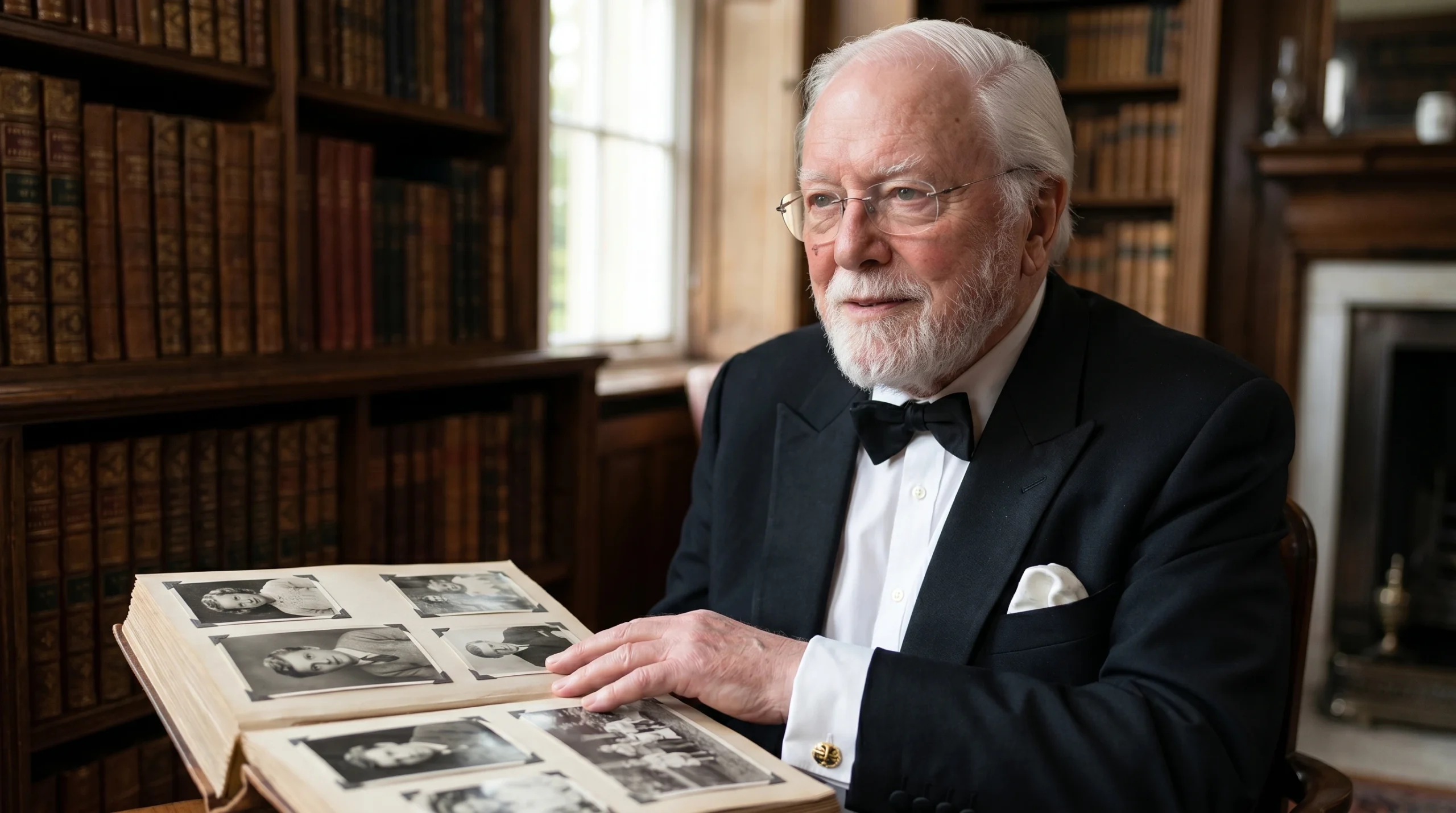
Robert Attenborough has spent much of his life close to one of the most famous surnames in British broadcasting while keeping his own life firmly out of the spotlight. He is best known to the wider public as the son of Sir David Attenborough, the naturalist and broadcaster whose voice has narrated the natural world for generations. Yet Robert’s own career took him in a quieter but serious direction: biological anthropology, human population studies, and academic research connected especially with Papua New Guinea. For readers searching “robert attenborough age,” the most honest answer is that his exact birth date has not been clearly confirmed in the public record, though the family timeline places him most likely in his seventies.
That uncertainty is part of what makes Robert Attenborough different from his famous father and uncle. David Attenborough’s age, career, honors, and public milestones have been documented in detail for decades, and Richard Attenborough’s film career generated an equally visible record. Robert has lived another kind of public life, one measured less by interviews and red carpets than by university appointments, field research, and scholarly work. His story is not one of celebrity inheritance but of a private academic who belongs to a famous family without appearing eager to trade on it.
Who Is Robert Attenborough?
Robert Attenborough is the son of Sir David Attenborough and Jane Elizabeth Ebsworth Oriel. David and Jane married in 1950 and had two children, Robert and Susan, before Jane’s death in 1997. Robert is commonly identified in public reports as Dr Robert Attenborough, a biological anthropologist linked with the Australian National University and the University of Cambridge. His professional interests have included human population biology, health, nutrition, demography, and research in Papua New Guinea.
For many people, Robert first appears in search results as part of the Attenborough family tree. That is understandable, because his father is one of the most respected broadcasters in the English-speaking world. But Robert is not a television presenter, actor, or entertainment figure. The available public record shows him primarily as a scholar, and that is the fairest way to understand him.
His low public profile has created a strange imbalance in online curiosity. Readers can easily find detailed accounts of Sir David’s documentaries, awards, and public advocacy, but far less about Robert’s personal life. That gap has encouraged some websites to guess at details that are not firmly documented. A careful biography has to resist that temptation and separate what is known from what is merely assumed.
Robert Attenborough Age: What Can Be Verified?
Robert Attenborough’s exact age is not reliably confirmed in widely available public biographical sources. The strongest public profiles of him focus on his academic roles and research rather than his birth date. Based on his parents’ marriage in 1950 and his identification as one of their two children, he was likely born in the early years after that marriage. That places him most likely in his seventies as of 2026, but any exact age should be treated as an estimate unless supported by a verified record.
This may seem like a small distinction, but it matters in biography. A precise age without a trustworthy source can make an article look more complete while making it less accurate. Robert has not lived as a full-time public figure, and there is no clear reason that every personal detail of his life should be public. His age is a natural search question, but the available evidence supports caution rather than false certainty.
The family timeline gives readers a useful frame. Sir David Attenborough was born on May 8, 1926, and married Jane Elizabeth Ebsworth Oriel in 1950. Their son Robert belongs to the next generation, not to the generation of David and Richard Attenborough. That means Robert should not be confused with his father, who turned 100 in 2026, or with his uncle Richard, who died in 2014.
Early Life and Family Background
Robert Attenborough was born into a family where learning, performance, public service, and curiosity carried real weight. His father, David, grew up in Leicester and later became one of the BBC’s defining figures in natural history broadcasting. His uncle Richard Attenborough became an acclaimed actor, director, and producer, while another uncle, John Attenborough, worked in the motor industry. The family’s public reputation was built across different fields rather than through one single path.
Robert’s mother, Jane Elizabeth Ebsworth Oriel, lived a much quieter life than her husband. She married David before his global fame reached its later scale, and their marriage lasted until her death in 1997. David has spoken over the years about the importance of family, though he has also acknowledged that his work kept him away for long stretches. Robert and his sister Susan grew up with a father whose career required travel to remote places and long absences from home.
That childhood context helps explain why Robert’s later academic interests do not feel surprising. The Attenborough household was connected to science, nature, education, and public culture. Yet Robert did not simply duplicate his father’s path. He moved toward human biology and anthropology rather than broadcasting wildlife to mass audiences.
Education and Academic Direction
Robert Attenborough’s education is not documented in the same public detail as his father’s BBC career. What is clear is that he developed a professional life in biological anthropology, a field that studies humans through biology, environment, evolution, culture, health, and population change. That discipline sits between the natural sciences and the social sciences. It asks how human communities live, adapt, reproduce, fall ill, and change across time.
His later appointments show the seriousness of that academic path. Robert has been associated with the Australian National University, where he has been listed as an Honorary Senior Lecturer. He has also been linked with Cambridge’s McDonald Institute for Archaeological Research as a Senior Fellow. These affiliations place him within respected academic settings rather than the entertainment world that made his surname famous.
Biological anthropology is not the kind of field that often produces household names. Its work usually appears in books, journals, field studies, research networks, and university profiles. That may partly explain why Robert remains relatively unknown to casual readers. His career was not designed for public celebrity, even though the family name inevitably attracts public attention.
Research in Papua New Guinea
One of the most meaningful parts of Robert Attenborough’s public academic record is his work connected to Papua New Guinea. His research interests have been described as including health, nutrition, and demography in the country. Papua New Guinea has long drawn the attention of anthropologists because of its cultural, linguistic, ecological, and biological diversity. For a scholar of human population biology, it offers a complex setting for studying how people live in relation to environment, history, and social change.
Robert’s name is associated with the edited volume Human Biology in Papua New Guinea: The Small Cosmos, published by Oxford University Press in 1992 and edited with Michael P. Alpers. The book reflects the kind of work that defines serious academic contribution: collaborative, data-driven, and attentive to local human variation. It is not the work of a celebrity relative dabbling in science. It belongs to a long research tradition concerned with human health, adaptation, and population structure.
The focus on Papua New Guinea also gives Robert’s career a distinct identity. His father became famous for bringing animals, ecosystems, and environmental change into living rooms around the world. Robert studied humans as biological and social beings, often in places far from the British public stage. The overlap is a shared interest in life, environment, and adaptation, but the methods and audiences are very different.
Career at the Australian National University
Robert Attenborough’s connection with the Australian National University is one of the clearest parts of his professional biography. ANU has identified him as an Honorary Senior Lecturer in the College of Arts and Social Sciences. That title suggests a continuing academic relationship, often held by scholars who contribute to research, supervision, teaching, or institutional life without necessarily occupying a standard full-time post. It also confirms that his work has been taken seriously in a major research university.
The Canberra connection has appeared in public reporting because Sir David Attenborough visited the city over the years and had family ties there through Robert. That detail has made Robert part of some stories about David’s visits to Australia, though usually only briefly. For Robert himself, Canberra was not a celebrity backdrop but a professional base. It placed him within a university known for research across the Pacific region.
Australia also makes sense in relation to his academic interests. ANU has long had strong research links with Asia and the Pacific, including Papua New Guinea. A scholar working on human biology, health, and demography in that region would find a natural institutional home there. Robert’s career therefore fits the geography of his research as well as the structure of his field.
Cambridge and Scholarly Standing
Robert Attenborough has also been associated with the University of Cambridge, where he has been listed as a Senior Fellow at the McDonald Institute for Archaeological Research. The McDonald Institute is a respected center for archaeological and anthropological scholarship. His listed areas have included human population biology and health, human evolutionary and behavioural ecology, and regional interests in Oceania and the Pacific. These fields match the wider pattern of his known work.
Cambridge gives Robert’s biography another layer of continuity with British academic life. His father studied natural sciences at Clare College, Cambridge, before joining the BBC. Robert’s own Cambridge connection is professional rather than simply familial. It links him to research communities concerned with human origins, adaptation, archaeology, and population history.
What stands out is the steadiness of his academic identity. Robert does not appear as a person drifting around the edge of fame. He appears as a scholar with a defined set of interests, institutions, and research geography. That is a quieter kind of recognition, but it is real recognition.
Relationship with Sir David Attenborough
Robert Attenborough’s relationship with his father is mostly private, as it should be. Public accounts identify him as one of David and Jane Attenborough’s two children, along with Susan. David’s work took him around the world, and he has been open in broad terms about the demands that travel placed on family life. Even so, the family remained an important part of his personal story.
Robert’s name often appears in articles about David because readers want to know whether the broadcaster’s children followed him into public life. The answer is no, at least not in the same way. Robert built a scholarly career, while Susan has been described in public accounts as having worked in education. Neither child has sought the same level of public attention as their father.
There is a quiet dignity in that separation. The children of famous people often get flattened into supporting characters in someone else’s story. Robert Attenborough’s life reminds readers that a famous family name does not automatically define a person’s ambitions. His work belongs to universities and research settings, not to the machinery of celebrity.
Marriage, Children, and Private Life
Details about Robert Attenborough’s marriage, children, or current domestic life are not widely confirmed in reliable public sources. That absence should not be treated as mystery or scandal. Many academics keep their family lives out of public view, especially when their public relevance comes from research rather than entertainment or politics. In Robert’s case, privacy also seems consistent with the way he has lived outside the media glare surrounding his father.
There is no responsible basis for inventing claims about his spouse, children, home life, or personal relationships. Some online profiles try to fill these gaps, but unsupported biographical detail can quickly become misinformation. A respectful profile should acknowledge the boundary and stay with facts that can be defended. Robert’s public life is best documented through his academic work and family connection to David Attenborough.
That privacy may also be part of why readers search for him. The less a person appears in interviews or public events, the more curiosity grows around basic details. But curiosity does not erase the difference between public information and private life. Robert Attenborough’s story can be told meaningfully without pretending to know what he has chosen not to share.
Net Worth and Money Questions
There is no credible public estimate of Robert Attenborough’s net worth. Unlike entertainers, public company executives, or major media personalities, academics usually do not have financial profiles that can be estimated with any confidence. His income would likely have come from university work, academic appointments, research activity, and possibly publishing, but the exact figures are not public. Any website claiming a precise net worth for him should be treated carefully unless it explains its method and sources.
This is another area where the Attenborough surname can mislead readers. Sir David Attenborough’s career in broadcasting has generated public discussion of his earnings, honors, and professional value. Robert’s academic career operates in a different financial world. University salaries, research roles, and fellowships do not translate neatly into celebrity wealth estimates.
The most honest answer is also the simplest. Robert Attenborough’s net worth is not publicly verified. There is no solid evidence that his financial life is central to his public biography. His known contribution lies in scholarship, not business ventures or entertainment income.
Public Image and Media Attention
Robert Attenborough’s public image is unusually modest for someone with such a recognizable surname. He is visible enough to be identified as David Attenborough’s son and as a scholar, but not so visible that his private life has become part of the entertainment press cycle. His appearances in public writing tend to be brief, factual, and connected either to his father or to his academic roles. That restraint has shaped the way readers encounter him.
There is a difference between being private and being obscure. Robert’s academic work gives him a record, but it is not a record built for mass attention. He has not needed fame to make his work meaningful, and he has not appeared to court it. In an age where celebrity relatives often become public figures by association, his distance from that pattern is striking.
The result is a public profile that feels both clear and incomplete. We know his family background, his general career field, and some of his institutional affiliations. We do not know many personal details, and the record does not invite speculation. That balance should guide any serious biography of him.
Why Readers Still Search for Him
Interest in Robert Attenborough tends to rise whenever Sir David Attenborough returns to the news. David’s major birthdays, new documentaries, environmental statements, and honors naturally lead readers to ask about his family. Robert becomes part of that curiosity because he is David’s son, but the search often expands from there. People want to know whether he shares his father’s interests, whether he works in science, and how old he is now.
The age question is especially common because it gives readers a quick way to place him in the family timeline. Knowing that Robert is likely in his seventies helps make sense of David’s long life and career. It also reminds readers that David Attenborough is not only a public figure but the head of a family that has now spanned several adult generations. Biography often begins with dates because dates help us understand scale.
But Robert’s story is more than a date. The more interesting answer is that he followed a related but separate path from his father. Both men have been connected to science, nature, and human understanding, but one became a broadcaster and the other an academic. That difference gives the Attenborough family story more depth than a simple celebrity lineage.
Common Misunderstandings About Robert Attenborough
One common misunderstanding is that Robert Attenborough is a broadcaster like his father. The available public record does not support that. He is known as a biological anthropologist, not as a television presenter or producer. His career belongs to research and universities rather than popular media.
Another misunderstanding involves his age. Some readers assume that because David Attenborough’s birth date is easy to find, Robert’s must be equally available. It is not. Robert’s exact date of birth has not been firmly established in the public sources most readers can check.
A third misunderstanding is that being part of the Attenborough family automatically means being a celebrity. Robert’s life shows that public recognition can exist in different degrees and different settings. He is connected to fame by family, but his own work has been quieter and more specialized. That distinction is essential to treating him fairly.
Where Robert Attenborough Is Now
Robert Attenborough’s most current public identity is as an academic figure associated with ANU and Cambridge. He has been listed as an Honorary Senior Lecturer at the Australian National University and as a Senior Fellow at Cambridge’s McDonald Institute for Archaeological Research. These roles suggest continuing scholarly standing rather than a public retirement narrative. They also show that his name remains attached to active academic institutions.
There is limited public information about his day-to-day life now. That is not unusual for a scholar who has kept a low public profile. He does not appear to maintain a celebrity-style media presence, and there is no strong evidence that he seeks public attention. His current status is best described through his institutional affiliations and the lasting relevance of his research interests.
For search readers, the key point is clear. Robert Attenborough is alive in the public record as a private academic, not as a media personality. His exact age remains unconfirmed, but his likely generational place is clear. He is the adult son of Sir David Attenborough, probably in his seventies, with a career rooted in biological anthropology.
Frequently Asked Questions
How old is Robert Attenborough?
Robert Attenborough’s exact age is not publicly confirmed in the strongest available biographical records. Based on his parents’ 1950 marriage and his place as one of David and Jane Attenborough’s two children, he is most likely in his seventies as of 2026. Any exact age should be treated with caution unless it comes from a reliable public record.
Who are Robert Attenborough’s parents?
Robert Attenborough’s parents are Sir David Attenborough and Jane Elizabeth Ebsworth Oriel. David and Jane married in 1950 and had two children, Robert and Susan. Jane died in 1997 after a long marriage to David. Robert’s family connection is the main reason many readers first search for him.
What does Robert Attenborough do?
Robert Attenborough is a biological anthropologist and academic. His public record links him with the Australian National University and the University of Cambridge. His research interests have included human population biology, health, nutrition, demography, and Papua New Guinea. He is not known as a broadcaster or actor.
Is Robert Attenborough related to Richard Attenborough?
Yes, Robert Attenborough was related to Richard Attenborough through his father. Richard Attenborough was Sir David Attenborough’s elder brother, which makes him Robert’s uncle. Richard became famous as an actor, director, and producer, while David became famous as a broadcaster and naturalist. Robert followed a much quieter academic path.
Does Robert Attenborough have children?
Robert Attenborough’s children, if any, are not clearly documented in reliable public sources. His private family life has not been widely reported, and there is no reason to treat unsupported claims as fact. The most responsible approach is to say that this part of his life remains private. His public biography is better grounded in his research and academic roles.
What is Robert Attenborough’s net worth?
Robert Attenborough’s net worth is not publicly verified. Because he is an academic rather than a celebrity entertainer or public business figure, there is no reliable basis for a precise estimate. Claims that assign him a specific fortune should be read with care. His known public value lies in scholarship rather than published financial figures.
Is Robert Attenborough still connected to academia?
Yes, Robert Attenborough has been publicly listed in connection with academic institutions including the Australian National University and the University of Cambridge. His profile has been tied to biological anthropology, human population biology, health, and Pacific research. The available record presents him as a scholar with continuing institutional recognition. That remains the clearest picture of his public status.
Conclusion
Robert Attenborough’s life sits at an unusual intersection of fame and privacy. He belongs to one of Britain’s best-known cultural families, yet he has lived in a way that resists the easy habits of celebrity biography. Readers may arrive searching for his age, but the more revealing story is how little he has depended on public attention. His identity has been shaped by scholarship more than publicity.
The best answer to “robert attenborough age” is careful rather than flashy. His exact birth date has not been reliably confirmed in the public record, though the family timeline makes it likely that he is in his seventies as of 2026. That uncertainty should not be filled with guesswork. It should be handled as part of a respectful account of a private person.
What remains clear is that Robert Attenborough built a serious academic life of his own. His work in biological anthropology, especially around human biology and Papua New Guinea, gives him a professional identity separate from his father’s fame. He may never be as publicly known as Sir David Attenborough, but that was never the point of his career.
In the end, Robert Attenborough matters because he shows another side of a famous family’s legacy. The Attenborough name is often associated with cameras, narration, and cinema, but it also belongs to scholarship and research. His story is quieter, but it is still worth telling with care.
